






Which SUV fits daily driving and weekend trails around Pewaukee, WI better — 2026 Jeep Wrangler or 2026 Toyota 4Runner?
City Jeep of Brookfield – Which SUV fits daily driving and weekend trails around Pewaukee, WI better — 2026 Jeep Wrangler or 2026 Toyota 4Runner?
When shoppers ask which SUV is better for daily driving and weekend trails around Pewaukee, WI, the conversation quickly centers on control, comfort, and flexibility. The 2026 Jeep Wrangler and 2026 Toyota 4Runner are both serious off-roaders, but they take different philosophical paths. One favors solid-axle articulation and open-air freedom; the other leans on a refined, modern platform with strong available hybrid torque and advanced driver assistance. If your commute includes smooth stretches across Capitol Drive and your weekends involve gravel two-tracks or a kayak run to the Fox River, a thoughtful breakdown helps you decide which path is right for you.
How they’re built and why it matters
Wrangler’s foundation remains purpose-built: solid front and rear axles, stout frame protection, and a range of 4×4 systems from part-time Command-Trac to full-time Rock-Trac with a 4:1 low ratio. This geometry pays off when you need tire contact and precise wheel placement at low speeds. The 4Runner’s TNGA-F chassis delivers body-on-frame durability with an independent front suspension and a solid rear axle, plus an available Stabilizer Disconnect Mechanism that increases articulation. It’s composed and confidence-inspiring over broken pavement and washboard roads. For everyday driving, the 4Runner’s road isolation appeals; for technical trails, Wrangler’s consistent articulation and available front-and-rear lockers offer an advantage in slow, uneven conditions.
Powertrains that fit real life
Wrangler offers two proven engines: a 3.6L Pentastar V6 and a 2.0L Turbo I4, both paired to either a slick-shifting automatic or a rare-for-the-class 6-speed manual. That manual matters for enthusiasts who equate precision with control in low range. The 4Runner brings a compelling pair of 2.4L turbo options: the i-FORCE (278 hp/317 lb-ft) and the i-FORCE MAX hybrid (up to 326 hp/465 lb-ft). On paper, the Toyota’s hybrid torque shines for towing and merges. But on tight, rutted access roads where you “set” the tires with an inch of throttle and clutch modulation, Wrangler’s manual availability and deep crawl gearing are tough to beat.
Tech and visibility you’ll actually use
Wrangler equips an available 12.3-inch Uconnect 5 touchscreen that feels intuitive on the move, with off-road pages and simple integration for Apple CarPlay and Android Auto. Radar positioning above the mirror preserves your front bumper for off-road accessories. Toyota counters with a crisp 14-inch multimedia screen, Toyota Safety Sense 3.0, and the available Multi-Terrain Monitor to display underbody views. For trail visibility, Wrangler’s upright windshield and clear fender lines make it easy to place a tire on a notch or avoid a rut, which can be just as important as any camera view when the sun hits the glass and reflections increase.
- Construction focus: Wrangler leans into solid-axle articulation and lockers; 4Runner blends IFS comfort with a disconnecting stabilizer bar.
- Control at low speed: Wrangler’s manual transmission and 4:1 low-range Rock-Trac system make technical crawling more deliberate.
- Everyday tech: Wrangler’s 12.3-inch Uconnect is fast and clear; 4Runner’s 14-inch screen and TSS 3.0 stack the Toyota with driver assists.
Open-air flexibility is where Wrangler changes the conversation. Doors-off drives and multiple roof options—Freedom Top three-piece hardtop, Sunrider soft tops, and the available Sky One-Touch power top—turn an average errand loop into a fresh-air reset. That’s not a novelty; it’s a quality-of-life feature that keeps stress levels down and makes the same roads feel new. The 4Runner offers a classic power rear window and a host of available accessories—including an onboard air compressor—that help outfit longer overlanding trips, but nothing matches Jeep’s top-and-doors transformation for day-to-day enjoyment.
Trail detail: how both SUVs climb, descend, and pivot
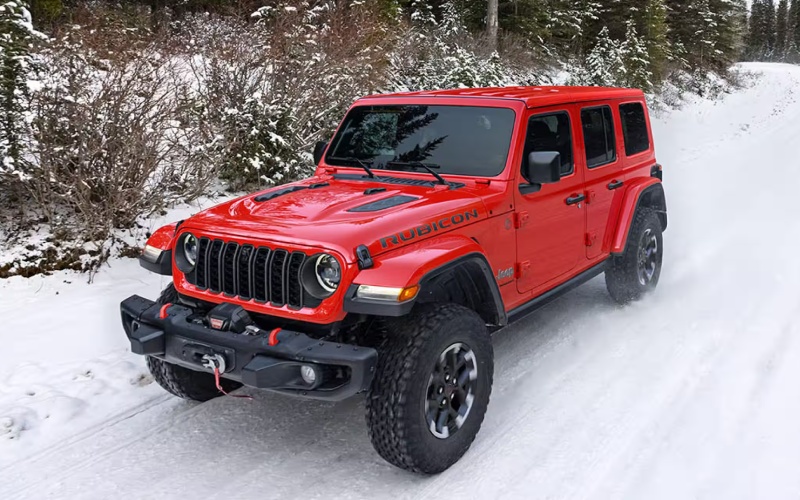
Approach and breakover angles matter around Pewaukee’s rutted access trails and when nosing up to a steep embankment. Wrangler 4-door models boast a Best-in-Class available 47.4-degree approach angle and can be equipped with 35-inch tires; together with strong skid protection, that reduces unwanted bumper taps and frame scrapes. The 4Runner’s ground clearance of up to 10.1 inches and its disconnecting front bar work well for clearance and articulation, especially on uneven, off-camber sections. Where the Jeep pulls ahead is the ability to keep the front axle loaded at low speed, then lock both axles when loose surfaces or diagonal ruts try to stop forward momentum. On the back end of a trail, the Wrangler’s compact turning radius makes pivoting in a tight gravel lot or switching back on a wooded path less stressful.
If you wrap most weeks with a quick trail ride or a boat ramp visit, consider Wrangler’s flat-tow readiness when properly equipped—a boon for RV owners. It’s a small detail with big travel implications, and a reminder that every part of the Wrangler’s design is meant to expand your options without complicating your routine.
Frequently Asked Questions:
Which SUV is more comfortable for commuting?
The 4Runner’s independent front suspension and available driver assists from Toyota Safety Sense 3.0 make it a strong commuter, while Wrangler’s updated steering and modern cabin tech make daily drives easy—plus you get the bonus of open-air flexibility when the weather cooperates.
Which is better for slow-speed rock crawling?
Wrangler, thanks to available Rock-Trac 4×4 with a 4:1 low range, an available 4.88 axle ratio, and the option for a manual transmission, provides extremely precise control on technical terrain.
Can I flat-tow either SUV behind my RV?
Wrangler is designed to be flat-towed when properly equipped. Most modern 4Runner configurations are not approved for flat towing; consult the owner’s manual for specifics.
Which has better visibility on the trail?
Both are strong—4Runner’s available Multi-Terrain Monitor helps with camera views, while Wrangler’s upright windshield, squared fenders, and shorter overhangs make “reading” obstacles straightforward without relying solely on screens.
Still deciding how this translates to your life? Bring your use case—weekday commutes, kid shuttles, boat ramps, cabin roads—and we’ll map features to moments. City Chrysler Dodge Jeep Ram Fiat of Brookfield can walk you through 4×4 options, top configurations, and accessories that will fit your routes. We’re proudly serving Pewaukee, Waukesha, and Milwaukee with test-drive routes that mirror the way locals actually drive, so you feel the difference where it counts most.
0 comment(s) so far on Which SUV fits daily driving and weekend trails around Pewaukee, WI better — 2026 Jeep Wrangler or 2026 Toyota 4Runner?